Showing posts with label Cameroon. Show all posts

23 December 2011

The Writer Enoh Meyomesse Said to be in Yaounde for Military Trial

22 December 2011
By Patrick Sianne


I met and had my very first converstaion with this very affable Francophone gentleman, rare in this bicultural Cameroon society, it was not even one month upon my sudden return from China last year, October, 2011.

We met at a send-off party for the then out-going country direct of the German Friedrich-Herbert foundation based in Bastos, Yaounde.

During that maiden encounter, I remember he hurried to present the grudge he was carrying in his belly against the minority Anglophone community in Cameroon. And the gripe was that even though he had written a both detailing their woes and has taken the courage to precribe solutions to the Anglophone Minority Problem in the country even against the heavily mounted resistance of the ruling Beti clan, his clan, the main Anglophone elite have been shunning him and his book to the extent that just one copy of the booklet has been bought thus far and he was not given a chance and even debarred from attending an All Anglophone conference in Buea, to make himself heard on this burning and controversial Cameroon problem.

We joked on the contradiction here entailed: that victims of a plight to refuse to give an ear to a benefactor who is convinced he is coming to help lighten their burden.

To cut this long introduction short we took an appointment and Enoh appreared with many copies of his pamphlet that I helped to retail with relative ease to the Anglophes I know and for which he was so greatful that he even offered me a bonus and discount for doing such a great job at distribution.

It was large because he then understook my inroads with books and literary matters from then onwards and because he saw how determined and advanced I was with the book I was then still on the writing-draft phase on my trip and travail in the Far East (China: My Regrets, My Fears--- A Rising Mirage for Black Africa), it was for these reasons and others that this very soft-spoken man of mid-fifties or nearly sixty decided to make of me the Vice-President of the organizing committee of a three-day national conference of Cameroon writers of both the English and French Expresses that the Biya government did everything in its capacity to sabotage late last year; even though Enow still managed to stage something that did not represent the full motions we all had bargained for.

The Yaounde regime, fearful of this its very son of the Centre-South, South indeed, just did not want to see this guy take the limelight on anything this spectacular, even though strictly cultural; even though Enoh had tried to use the habiyual ruse of placing the even "Under the Patronage of His Excellency Paul Biya, President of the Republic of Cameroon" and even though he had insisted that this was to be as part of the on-going official activities marking the 50th anniversary of the republic.

As I gathered during that moment when I was closing working with him gearing up for the Literary Show that wasn't finally, Enoh has for long then before been blackmailed by the Yaounde regime, especially when he is said to have made an audio recording announcing the toppling of the Biya regime for which he was arrested and tormented for plotting a coup d'etat.

And then again sometime during this dying year while the political feud was going on in the Cote d'Ivoire between Laurent Gbagbo and Alassane Ouatara, he was picked up again at the Douala airport, passport seized and he was detained again for a few days for unannounced reasons. What filtered through during that particular arrest is that as supporter of Laurent Gbagbo, and as a true anti-Imperialist and true PanAfricanist he was about to fly to the Cote d'Ivoire to voice his stance when the Biya cabal opted to nip his effort at the bud stage by picking him up at point of departure.

Since then, I tried without efforts again to reach him personally for a one-to-one. We had just a few meagre phone conversations and even the few times he made firm commitments to come see me at my residence around the Yaounde Prefecture proved to be furtile. I afterwards gave up on looking for him, for my instincts gave me a hunch as to why he may be trying to avoid meeting me: As we was so ardent and public in his support for Laurent Gbagbo, so too did he come to learn through our common sources and middlemen and women that I too was a fire rod in the opposing camp selling the stakes for Alassane Ouatara. This looked like the Cameroonian version of the love-hate opposition that is reported in the Ivorian drama fixing Soro Gillaume (Pro-Ouatara) and Blaise Blegoude (Pro-Gbagbo).

Perhaps for this last reason in particular, Enoh and Sianne stayed apart for this long. Even the presidential elections of October 9, where I was suurprised to learn via the press that he is one of the initial 51 or so applicants did not happen to bring us together, even though phone conversation alone. This, even though both of us are ardent believer that Biya Must Go. I was personally surprised that he put forward his candidature and never consulted with me before, during or even after the whole process of the reckless Decision 2011, the fake Cameroon Presidential Election that Biya roganized to win and won the way very few are satisfied with.

Of course therefore that Enoh was one of the disgruntled Cameroonians that that bogus pull. But such frustrations are not the things in my opinion that should lead him to do the things whatever they be that this wicked regime is using to give this noble birth of the South some much trouble of late.

One of our common friend, whose name I prefer withholding for she is a prominent national political player told me just this afternoon that they government forces have brought Enoh from the hole they were holding him in the distant East Region to Yaounde where he is expected to be judged in a military tribunal. Confirming reports via this face book mails also affirm that Enoh was spotted this afternoon being taking into and out of the Yaounde Military tribunal.

As a personal acquaintance and a sweet character to deal with I am still at a loss about what he may have done so bad this time around for his torment to be getting bigger than usual from the hand of this government that hates him and knows Enoh also hates the government back with equal or even hogher vehemence.

Tomorrow or soon after, we may get to the belly of the true story that may still what to see as just an attempt of this wicked regime to get even with this other critical artist like it did with Lapiro de Mbanga, using the pretext or cover of the 2008 nation food riot to lock him up in a tight hole at the Douala New Bell prison for several years, for crimes that the Mbanga-based musician said to me during a recent interview in his home with his wife present and looking at me straight in the eye: "Patrick Sianne, je n'ai rien fait de ce genre donc ce régime m'accuse. Le dossier est bien preparé, bien avancé, et on attend le bon moment pour te le mettre sur le dos. C'est fabriqué de toutes pièces!"

I smell a rat here, as same as with the Lapiro file.

17 October 2011

When Protest is Called “Disorder”

October 16, 2011 

By Juliette Abandokwe 


Douala, Cameroon 

On October 4th, five days before the general election, seventeen of Mboua Massok’s young militants were arrested as they were disseminating invitations for the next pre-electoral meeting to be held two days later. Mboua Massok, also commonly called “Acting Combatant”, has become over the years the symbol of resistance to the trivialization of the intolerable and ruthless rule of Paul Biya. 

According to the newspapers, the seventeen arrested youth are facing charges for having caused disorder; their trial will take place on Monday 17 October. 

A young 22 year-old Cameroonian on Facebook commented this arrest by saying that “they weren’t fighting for liberty but for disorder (according to the newspapers). The next one who’ll act in that sense will be punished and charged”. 

It is nice to know that in Cameroon one is punished first and then charged! 

This kind of talk just shows how well Paul Biya’s rule is using young Cameroonians in his efforts to disseminate terror, by convincing them to believe how bad it is to have a different opinion, and to stand up for it. These youth are then left to criss-cross all over the place for systematic intimidation and demonization of independent thinking. The warning of this young man is just drenched in abuse of power and impunity, supported by the climate of terror instilled by the brutal national system of repression. 

Biya's newspapers and television: A very efficient and well financed brainwashing scheme 

To protest against the high-jacking of basic liberties, against institutionalized brutality, and against the rape of a people's right to chose its leader freely, is not "fighting for disorder" as the Cameroonian state controlled media are proclaiming. That is the language of coldblooded dictation, aimed at the destruction of any attempt for self-determination. 

For the sake of their business, Paul Biya and France need a system in Cameroon where Cameroonians are superfluous. They would lose too much money if the people of Cameroon succeeded in standing up to ask for more justice and fair partnerships. So all heads must be kept down, and any head that comes up will be chopped off. That is in essence what the state media are telling Cameroonians. 

In reality, the self- and France- proclaimed part-time president has declared war on “his” people, by continuing the 51-year old denial of the right for the Cameroonian people to organize an efficient, coherent thus strong opposition. The global picture of today’s’ opposition is the direct result of a systematic psychosocial destruction of society, operated mainly through imported and well used propaganda methods. 

As protest is called “disorder”, everybody naturally agrees that is has to be put in order. That is part of the brainwashing procedure. In reality, Biya is forcibly suppressing any kind of protest, with the support of a completely rotten "justice" system, where it is his friends who are in charge. As he considers the Cameroonian people as superfluous, it would be contradictory if he cared about their fundamental rights. 

Biya, “The Choice of The People” 

For Paul Biya, the people of Cameroonian have no rights; his has done the utmost efforts to prevent them from asking for their civil liberties, by managing to make them believe that the misery they are living in, is what is called “peace”. 

Intimidation, repression and propaganda will not stop the wheel to turn round. When the “too much is too much” will have gone over the brim, the time will come when a miserable tyrant called Paul Biya will himself be punished and charged in the bitterest way. That moment is slowly coming, however sarcastic people think about it. 

That is except if he runs off without paying his bill, which at his age can happen anytime.

Evil ruling never lasts for ever

9 October 2011

Paul Biya, the Killer of Innocent Cameroonians

3 October 
Tila Bokado


Voice Of Cameroon is calling on the United Nations, the United States government, human rights organizations and media groups around the world to advise Paul Biya who have continuously torture and savagely murdered innocent Cameroonians , to watch his evil ways because we are ready to take down his armed chickens. We understand that they're some members of the Cameroon armed chickens who are dedicated to brutalize and murder innocent Cameroonians in order to please Paul Biya the tyrannic dictator. That will be the greatest mistake if that happen because our Freedom Troopers will use every means necessary to equalize any bloody killings in the South Cameroon camp by the evil regime. The Cameroon People's Liberation Troopers want the following issues to be resolved immediately between paul biya and Southern Cameroonians.

1.  Paul Biya must immediately release every Southern Cameroonian and political prisoners who are in prison or house of arrest. Our people have every rights to walk freely and enjoy their natural fatherland without fear of anyone.

2.     WE need the names of every Southern Cameroonian and political activists who are held captive by the illegal regime of Dictator paul biya. We have seen recent videos of filthy, crowded house of arrest and detention camps where our citizens are held captive by Paul Biya.

3.    If any Southern Cameroonian or citizen of Cameroon who have been arrested lost their life in the hands of paul biya and his armed chickens, that will be the beginning of a bloody war. The Cameroon People's Liberation Troopers will not sit and watch paul biya murder our citizens anymore. Those Cameroonians who are supporting Paul Biya will automatically be classified as enemies of the State because they are knowingly promoting violence by supporting a brutal dictator.

4.   We are giving paul biya less than 24 hours to meet our demands and if Paul Biya decided not to let them go, The People's Liberation Troopers will forcefully release every Southern Cameroonian and political prisoner in Cameroon.

8 October 2011

Live Either Free or Die

8 octobre 2011
Patrick Sianne


Let Paul Biya go, now! 

Let him vamoose and leave the Cameroonians held in bondage for this too long in an uncaring dictatorship, FREE. This Freedom that I am calling for is not just for me and my family members and friends. It is deep and meaningful Freedom that allows people to think and act and even fly freely without turning around and looking back and left and right to protect their back and sides from a dictator, be it this Biya’s or the one that may come after.

Liberty has no price. Many are those of the ruling cabal, friends inclusive, who have come to me in private and public, day time and in the thick of darkness at bight, to ask me, Patrick Sianne, since coming back from China, “Patrick, but what do you really want? We are prepared to fix your conditions, if you are ready to tell us, we settle it and you remain silent.

My answer to them has been then, now and tomorrow viz: “Let Paul Biya go, now! Let him vamoose and leave the Cameroonians held in bondage for this too long in an uncaring dictatorship, FREE. I want Freedom, so, has been my answer. This Freedom that I am calling for is not just for me and my family members and friends. It is deep and meaningful Freedom that allows people to think and act and even fly freely without turning around and looking back and left and right to protect their back and sides from a dictator, be it this Biya’s or the one that may come after.”

It is a natural law for all to be free. Man does not have to be a burden to man, as Biya has become one big bug to a cross section of Cameroon, just in an effort to preserve a power that he inherited accidentally on that objectionable, damned November 6, 1982.

Je pense donc je suis,” said Descartes, the famous French Mathematician-Philosopher to illustrate how vital is Freedom to Humans in particular and to society at large. Limiting Freedom is holding everyone and everything back from enlightenment and advancement.

So much of import is the necessity to feel free that one of the fifty states of the United States of America, Newhampshire, a State in the East Coast part of the USA called New England, adopted this telling slogan as its State Motto: “Live Either Free or Die.”

This notion is not of just today. It has a historical significance birthing right from the days of the American Revolution, the then nascent nation’s War of Independence from colonial and Imperialistic England or the United Kingdom.

Revolution is first and foremost a question of freedom of the mind. Bob Marley, the great legend of Reggae, underlined this fact in one of his hit tunes of liberation and redemption when he asked us to “emancipate yourselves from mental slavery, non but ourselves can free our minds.”

Sick and tired of oppression, exploitation and cheating by the British colonial masters, patriotic American nationalist of high intellects like Patrick Henry, Benjamin Franklin, Thomas Jefferson, James Madison, John Jay and Alexander Hamilton (Founding Fathers) , as revolutionary ideologues, set out first of all, to provide the ideas markets from which the people were to buy and use to use to free their mind to the critical point when they gather the necessary courage to start challenging the evil system fearing nothing else, but fear itself.

That was the trend of thoughts that pre-set the chain of events, little-step-by- little-step culminating in the famous Boston Tea Party when precipitated the transformations leading to the war and liberation of America under the able leadership of the person who became the first president, General George Washington, the man in honour for whom the capital of th present all-powerful United States of America is named in thanks for his selfless bravery and commitment to the noble cause of FREEDOM.

Message Approved by LVP: Libertas – Veritas – Probitas

Motto: One for all, all for One; All for one, one for All. What goes around, comes around!

Cameroon: Biya's Liberticidal Cruelty and his Free and Fair Election of 9 October 2011

5 October 2011
Patrick Sianne


While Mr. Biya has been always saying that he would like to be remembered the days after his too long a one-man show and reign over Cameroon to be remembered as the man who brought democracy in Cameroon he and his boys do all before and behind the scenes to kill the very freedoms he purported to want to nurture and culture. 


Some sort of democratic representation and representative is the ploy in play here, like any other system or policy that Mr. Biya has said he is instituting in Cameroon since November 6, 1982 that he took over from El Hadj Ahmadou Ahidjo as second present of the Second Republic of Cameroon.

Now that the English speakers of the Third Republic are staking their calim to a moral imperative to take the helm from Biya and preach by example by being the real purveyor belt for sustainable democratic institutions and traditions in Cameroon wth courageous woman and men like Kah Walla, Fru Ndi, Ayah Paul, Ben Muna and George Nyamndi, the Biya Boys are behind the scene wanting to thwart all the forces for change that is surfacing at the bud stage wherever and whenever they germinate or attempt to burst out.

Here is a new case arising in where the wonder lads of the very combative, radical Mboua Massock Movement have been picked up and put under keys at a gendarme jailroon somewhere in Bonanjo, Douala, as per this missive I just received via facebook from a trustworthy source.

This group of 17 were manhandled and taken off the street for nuisance, just because they were trying to say it loud, to speak like James Brown in his hit song of the sixties or seventies, tittled Say it Loud, I'm Black and Proud.

These proud and promissory and patriotic Cameroonian's were in the streets distributing flyers announcing a show-down with dictator Biya come October six, tomorrow Thursday, when the police visited with them unceremoniously and took them away against their basic human rights, not without a bare-arms resistance.

This other Douala public and unconstitutional cruelty by these forces of everything else but Law and order comes on the of the heavy crack down that is still to settle in Buea after the actvists of the Southern Cameroons National Council were prevented to hold their 50th anniversary commemorative grand rally by the same Biya liberticidal forces.

In Buea, the heavy arms used in the sweep was indiscriminate, catching even the watch-dogs of society, protectors and defenders of freedom of expression that are journalist in their noble role of news gathering and dissemination.

Patrick Sianne, Elvis Tah and Adams Bouddih, of The Post newspaper and Solomon Amabo of Equinoxe television are four of the know reporters impolitely accosted, violently molested and humiliated and then whisked of for detention and questioning and intimidation, just for being at the right place at the right time and attempting to do their job, provider of their daily living, how it is supposed to be ina real democracy, and not the simulacrum Paul Biya wants to seal and sell for real, this new election season again, as he has done to bag one genration of dilly-dallying at the head of the state. This callously executed political cacophony and buffoonery must come to nought this yea by any means necessary, see Malcolm X. It is the opinion of Libertas - Veritas - Probitas that the battle should leave the mainstreet to the mean street, where we the people can in quick shift respond to fire by fire, bully for bully, tit for tat.

3 October 2011

Paul Biya of Cameroon: Dictator of the month

26 September 2011
David Wallechinsky


On October 9, the nation of Cameroon in west-central Africa will hold a presidential election. There will be 23 candidates, but there isn’t much doubt which one will win…78-year-old Paul Biya, who has ruled Cameroon for 29 years. In fact, Biya is a specialist in creative rigging of elections. Once he even hired his own set of American election observers to report that an election he won was free and democratic (see below). This time around he has come up with a novel method of making sure that the outside world will be impressed by his defeat of a large number of opponents.

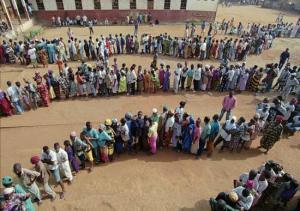
To run for president, a politician must put up 5 million Central African Francs (CFAs). He then receives 25 million CFAs to run his campaign. According to Cameroonian journalist Ntemfac Ofege, “All the candidates have to do is rush to the nearest bank, microfinance institution, credit union or whatever, and demand a short term loan of 5 million CFA. They collect 25 million CFA from the state; pay back their short-term loan and report a profit of at least 15 million CFA.”In my book Tyrants: The World’s 20 Worst Living Dictators, I included a chapter about Biya, which I present here.

The Nation

As a political entity, the West African nation of Cameroon was patched together by European colonial powers. The population of more than 16 million speaks 279 languages. Slightly more than half of Cameroonians are Christians, a quarter follow traditional belief systems, and about 22% are Muslims. There are approximately 260 distinct ethnic groups. Since a chi eving independence in 1960, Cameroon has been ruled by one party and only two presidents. Cameroon is Africa ’s largest producer of timber and it is the world’s fifth-largest producer of the cocoa that goes into making chocolate. The nation has the reputation of being one of the most corrupt countries in the world and actually earned Transparency International’s number-one ranking as corruption champion two years in a row, in 1998 and 1999.

Pre - Biya

The Germans claimed Cameroon as a colony in 1884. Following World War I, the Treaty of Versailles divided the colony between France and Great Britain . The French granted East Cameroon independence on January 1, 1960. On October 1, 1961, the British gave up control of West Cameroon and it joined East Cameroon to form a single country. French-educated Ahmadou Ahidjo, a Muslim from the north, took over as president and stayed in power for twenty-two years until he unexpectedly resigned on November 6, 1982, apparently because his French doctors told him that he had a terminal disease. Ahidjo did retain his position as head of Cameroon ’s lone political party. He was replaced as president by the prime minister, Paul Biya, a Roman Catholic from the Beti ethnic group in the south. Ahidjo did not have a terminal illness, but by the time he realized this, Biya had squeezed him out of the party leadership and forced him to flee the country. Ahidjo eventually died in Senegal in 1989.

The man

Born February 13, 1933, Biya studied in Paris and received a degree in public law. After working for two years in the presidential palace, he became director of the office of the minister of education and then moved up to secretary-general of the Education Ministry. After serving as secretary-general of the presidency, Biya was named prime minister by Ahidjo in June 1975.

At the time that Biya assumed office in 1992, Cameroon enjoyed a booming economy with solid exports of cocoa, timber, and coffee and a growing petroleum industry. Thanks to corruption and ethnic cronyism, Biya destroyed the economy. While Biya and his friends grew rich on oil money, the Cameroonian economy shrank for nine straight years beginning in 1987.

In January 1984, Biya stood for election for president and managed to win 99.98% of the vote. It is not known what happened to the two-hundredths of one percent of the voters who managed to vote against him. To be on the safe side, Biya eliminated the position of prime minister so that no rival politician could create his own power base. Three months after the election, he put down a mutiny by the mostly Islamic Republican Guard, which he blamed on Ahidjo, who was condemned to death in absentia. To demonstrate that he was not a dictator, Biya changed the name of the only legal political party from the National Cameroonian Union to the Cameroon People’s Democratic Movement (RDPC). In 1988, he was reelected president, although his vote percentage slipped to only 98.75%.

Controlling the opposition

Under pressure at home and from abroad, Biya legalized opposition parties in 1990, but strikes and pro-democracy protests in 1991 left more than 100 dead. Forty-eight parties took part in March 1992 legislative elections. The RDPC won 88 of the 180 seats and, with the help of sympathetic small parties, cobbled together a working majority. Presidential elections had been scheduled for a year later, but Biya moved them up to October 1992 to give the opposition less time to organize. The U.S.-based National Democratic Institute for International Affairs arrived in Cameroon to help train election officials, but stayed to observe the election and to watch in dismay as the government ignored normal democratic procedures. “It would not be an exaggeration,” the observers would later report, “to suggest that this election system was designed to fail.” The government-controlled television gave Biya 142 minutes of time to present his case, while allowing the opposition parties a combined total of 12 minutes. Names of eligible voters were crossed off the registry and there were widespread reports of multiple voting and voting by underage residents. In some areas known to be anti-Biya, polling sites were moved without warning to reduce turnout. The territory of Rey-Bouba in the district of Mayo Rey blocked all political party pollwatchers from entering. Results by polling site were never published.

The election took place on October 11. A week later, George Achu Mofor, the governor of East Province , resigned to protest the way the central government had forced him to use any means necessary to ensure a Biya victory in his province. The election results were announced on October 23. Biya won with 39.9% of the vote. John Fru Ndi, the English-speaking head of the Social Democratic Front, was given 35.9%, an affront which landed him in house arrest; and a third major candidate, former prime minister Bello Bouba Maigari, won 19.2%. Demonstrations in English-speaking Western Cameroon were so large that Biya imposed a state of emergency in the region and ordered mass arrests of opposition supporters. Despite the dubious aspects of the election, the French government congratulated Biya on his victory. At the time, the French oil company Elf Aquitaine monopolized oil exploration off the coast of Cameroon .

In 1996, students at the University of Cameroon ’s Yaounde 1 campus boycotted classes to protest a hike in fees that was so broad that it included usage charges both for the library and for toilets. When the strike spread to other campuses, the government sent in troops who beat a student to death. By the time of the 1997 parliamentary elections, Biya had learned his lesson. His party manipulated the voting much more efficiently and gained a clear majority of the seats. In the presidential election later that year, Biya claimed to win 92.6% of the votes.

By this same time, Biya was cracking down on privately owned newspapers, arresting and imprisoning journalists. In one particularly notorious case, Pius Njame, the editor of an independent French-language newspaper, reported that Biya had suffered a “malaise” and a possible heart attack while attending the 1997 Cameroon Cup soccer final. Njame was convicted of “spreading false news” and served ten months in prison.

The Pipeline

Although Cameroon attracted the attention of the oil industry, its reserves were relatively limited. But the industry had other plans for Cameroon . Northeast of Cameroon , the landlocked nation of Chad was found to have plenty of oil. A consortium of ExxonMobil, Royal Dutch Shell, and Elf Aquitaine drew up plans for a $3.7 billion project that would sink 300 wells in Chad and run the oil to the Atlantic coast via a 665-mile-long pipeline they would build across Cameroon . Because the regimes of both Biya and Chad ’s Idriss Déby were notorious abusers of human rights, and because of the high potential for environmental degradation, Shell and Elf pulled out of the project. With billions of dollars of profits on the line, ExxonMobil found two new partners, Chevron and Petronas of Malaysia, and plunged ahead in promoting the plan. Construction of the pipeline, which began in October 2000, threatened the destruction of the lives of 100,000 Bagyeli Pygmies living in the region and in some cases their eviction. The World Bank backed the project, making it the bank’s single-largest investment in sub-Saharan Africa , and the pipeline was completed in July 2003.

Meanwhile, human rights groups were reporting systemic torture, the kidnapping and disappearance of political dissidents, and a legal code that permitted forced female genital mutilation and allowed rapists to avoid prosecution if they marry their victims. Biya keeps such tight control over the country that his office approves all public appointments all the way down to village police officers.

In the words of lawyer Charles Taku, “To get such a job or a business license…you have to show that you support the president actively, that you love him and his party.”

Human rights, the vanishing Act

In 2002, Paul Biya caught a break. Cameroon happened to be serving a two-year term as a member of the United Nations Security Council when U.S. president George W. Bush decided to invade Iraq and needed the support of Security Council members. Biya, a longtime friend of France ’s president, Jacques Chirac, found himself being wooed by Bush and visited him in the White House the day that the U.S. began its bombing of Baghdad . U.S. secretary of state Colin Powell praised Cameroon as “a place of stability” and promised that “we will do everything we can to strengthen the government.” The criticisms of Biya’s human rights record, which had been catalogued in the reports of Powell’s own State Department, were swept aside as if they had never happened.


Creative election rigging

In 2004, Biya faced a new presidential election and came up with a new and novel tactic in the world of rigged elections. In previous elections he had perfected the arts of suppressing opposition campaigning and stacking the voter rolls. But he faced criticism from international election-monitoring groups. In July 2004, he signed a $400,000 deal with the Washington, D.C., law and lobbying firm of Patton Boggs to improve Cameroonian ties with the United States at a time when the State Department had said that Biya’s security forces had “committed numerous unlawful killings and were responsible for torture, beatings and other abuses,” and that the government “continued to arrest and detain arbitrarily various opposition politicians.” One of the Patton Boggs lobbyists, former U.S. Representative Greg Laughlin, a Texas Democrat, put together a bipartisan observer group called the U.S. Association of Former Members of Congress. With Biya’s government covering the bills, the Association flew in six ex-congressmen, who observed the October 11 presidential election in which Biya claimed a 71% landslide, declared it a free election, and flew home.

One of the former congressmen, Ronnie Shows, a Democrat from Mississippi , enthused, “This is what democracy is about.” Another observer group from the Commonwealth nations, led by former Canadian prime minister Joe Clark, saw the election process differently. They said that the registration process, which the U.S. group had arrived too late to observe, had “missed a considerable portion of the voting-age population of Cameroon .” “We ran into swarms of people who had been declared ineligible to vote,” said Clark . The Catholic Bishop’s Conference of Cameroon also accused Biya’s government of vote-rigging.

The ectoplasm

Biya’s first wife, Jeanne-Irene, died in 1992, leaving behind two sons and a daughter. Two years later the sixty-one-year-old Biya married a twenty-four-year-old named Chantal and began spending an increasing amount of time on vacation. Cameroon ’s leading novelist, the late Mongo Beti, once described Biya as an “ectoplasm” and another time as a “zombie.” Because Beti also had harsh words for John Fru Ndi, Biya let him get away with it, although Beti was roughed up by police at demonstrations.

28 July 2011

Cameroon: How Paul Biya Treats Unarmed Civilian Protestors

27 July 2011
Juliette Abandokwe


The video below, which was made on February 23rd of this year, shows how Cameroonian police and armed forces behave towards unarmed civilian protestors. 

It particularly indicates with which brutality Paul Biya, who has been the President of Cameroon for 29 years now, is treating those people of his who have been "democratically and freely" electing him for the past 3 decades. 

This years' general election is taking place on the October 9th. 

Paul Biya, having manipulated the Constitution in December 2007, removing the terms' limit, which allows him to present himself for as many terms that he wishes, declared himself the candidate of the ruling RDPC (sarcastically, the Democratic Reassembly of the Cameroonian People) only a couple of weeks ago. 

Widespread repression has been occurring since February, with extensive intimidation methods as well as unarmed civilians being brutalized, imprisoned and tortured, together with systematically molested and house arrested opposition leaders. 

France, the former colonial power and until present neo-colonial power, which has gigantic commercial interests and contracts in the custody of the Cameroonian government, know exactly, together with the European Union and the rest of the international community, what is going on in Cameroon. Several detailed reports have been issued in the last three years on the absolutely appalling human rights situation. 

Systematic manipulation of the independent electoral commission ELECAM has been going for over a year now, with the choice of its members by Mr. Biya being regularly questioned by civil society and opposition leaders. 

If or when Biya wins the next elections, how far will the international community go to validate the result of the election, and how concerned will they feel the gross human rights violations, and remembering that France and its partners condemned and ousted President Laurent Gbagbo of Ivory Coast out of power for allegedly having rigged and lost the 2010 autumn general elections after 10 years of power, along alleged crimes against humanity. 

Incidentally, it is also to be remembered that France is responsible for extended massacres in Cameroon during the war of independence, where between 300 000 to 400 000 Cameroonians villagers died in the napalm bombings by the French air force. No official history book mentions these events, but many survivors as well has French pilots present at the time, have officially witnessed. 

To what extent is it a crime against humanity for the international community to accept and to validate, even "only" implicitly, an election which is the absolute result of obvious, widespread and systematic fraud, accompanied by a long and very painful history of extremely gross power abuse and basic human rights' violations? 

Why should Gbagbo be removed for those reasons, and to a lesser extent Kadhafi, while people like Paul Biya, Idriss Deby of Tchad, François Bozizé of Central African Republic, the latter two having proclaimed themselves successor to their previous term after systematic and arrogant fraud at the beginning of this year, ar keft in power? 

These questions are obviously linked to the quality of warranty offered by these "democratically and freely" elected "presidents" on the availability of natural resources' contracts and deals in unclear and corrupt conditions. We should therefore ask ourselves to what extent the power of a brutalized and silenced people can be exercised in these different conditions. Although internal interacting factors should also be considered, ranging from longstanding toxic behaviors induced by will-suppressing colonial rule, as well as widespread greed and lack of national conscience, the weight of external validation and acceptance should be considered as overwhelming. 


This video is to show how Biya is intending to continue ruling over his people
 while he is trying very hard to become his own successor at any cost. 


3 June 2011

Cameroon: President Biya's French Spin Doctors

2 June 2011
Bisong Etahoben


Cameroon’s President Paul Biya’s recent participation at the inauguration of Ivorian President Alassane Ouattara may have been low-key, but it has set off a cold war between France’s main public relations outfits. In effect, Patricia Balme, the 52-year-old founder of the French publicity agency Pb Com International, who has been Biya’s spin doctor and image builder for about 20 years, may lose that position to Image 7, another French PR agency.

This follows what presidential insiders in Yaounde describe as “fruitful talks” in Yamoussoukro during the Ouattara inaugural between President Biya and Anne Méaux, an adviser at Image 7.

Also in the running for the Biya PR slot is Stéphane Fouks, head of the international communication agency Worldwide Euro Rscg, who for the past four years, formulated the communications strategy in France of disgraced former IMF managing director Dominique Strauss-Kahn.

Grand priestess

It should be noted that Image 7 was hired by the Ouattara Inauguration Organising Committee to give the extra shine to the occasion and Anne Méaux was the agency’s point person, who did the marketing of the inaugural.

Described by French media as the “grand priestess of Image 7”, Ms Méaux for many years marketed the image of toppled Tunisian leader Zine el-Abidine Ben Ali and currently does public relations work for President Abdoulaye Wade of Senegal.

She also recently signed a contract with President Ouattara to market his image to the world.

President Biya’s decision to give a closer atteention to Ms Méaux may have been dictated by the fact that she has the ear of several officials in the Elysée Palace. This would be a plus for the Biya presidential entourage, especially at this time when relations between Yaounde and Paris have not been at their best.

France, it should be noted, has been vocal against long-serving African leaders and Biya, who has been in power since 1982, is one of the longest serving African presidents still in power. He intends to stand for re-election in October.

Their boosters

Ms Méaux made her éntree into the world of communications when she was hired to market the image of former French president Valéry Giscard d’Estaing.

In spite of her impressive cv, Ms Méaux does not seem to have clinched the Biya communication contract yet. Her two competitors for the job, Patricia Balme and Stéphane Fouks, also have their boosters in the Yaounde presidential palace.

In spite of all the fuss about the hiring and firing of foreign spin doctors by President Biya, the race for the presidency will largely depend on the Cameroonian voters, who alone have the right to decide who their leader will be.

In fact, the president’s dependence on the foreign media to build his image has not endeared him to the local media, especially given that since coming to power 29 years ago, Biya has never organised a press conference with Cameroonian media.

24 May 2011

Cameroon Government Dismisses Opposition Threats to Disrupt Polls

23 May 2011 
Peter Clottey 


Cameroon’s information minister has dismissed a threat by the main opposition Social Democratic Front [SDF] to disrupt the October presidential election.

He calls the threat “overly ambitious and pretentious.”

Issa Tchiroma, who also heads the opposition Front for the National Salvation of Cameroon, says allegations of repression, intimidation and harassment of opponents of the ruling party are unfounded.

“They have no grounds [and] no reasons whatsoever [to disrupt the election] because they haven’t been mandated by the opposition in general,” said Tchiroma.

The SDF claims irregularities during the recent voter registration process.

But, Tchiroma said the opposition has failed to use proper channels to address their concerns ahead of the vote.

“[They are] completely wrong. They use a prism, which completely distorts the reality. This is fact,” said Tchiroma.

He said the SDF will be contravening the constitution if it disrupts the vote.

Tchiroma denies accusations that opponents of the administration are being prevented from campaigning on radio and television.

“The state does not interfere at all in the editorial lines of those television [and radio] stations,” Tchiroma said.

But, the leader of the main opposition party, John Fru Ndi, insists there is no level-playing field and that the electoral commission lacks independence, which he said will undermine the credibility of the presidential vote.

“The opposition has for years been calling for an independent electoral body that will conduct elections that will be free, fair and transparent. But, they ignored all of them,” said Fru Ndi.

He also said that the composition of the top leadership of the electoral commission comprises former members of the ruling Democratic Rally of the Cameroonian People [RDPC], a charge the RDPC denies.

“It is easier and better for us to disrupt the elections and we stop there and make sure that things go rightly in Cameroon than to take the North African style [uprisings],” said Ndi.

The electoral commission says so far, five presidential aspirants, including incumbent President Paul Biya, have declared their intentions to run in the October elections.

21 May 2011

US Urges Cameroon to Hold Free and Fair Election

19 May 2011
TrustLaw


U.S. Secretary of State Hillary Clinton urged Cameroon on Thursday to hold a free and fair presidential election, expected in October this year. President Paul Biya, 78, has ruled Cameroon since 1982 and is one of Africa’s longest-serving presidents. He is expected to seek another term in the election after tweaking the constitution in 2008 to remove term limits.

“We look forward to seeing the people of Cameroon exercise their right to vote later this year in a free, fair, and credible presidential election,” Clinton said in a message ahead of Cameroon’s national day which is celebrated on Friday.

Clinton said the United Nations remained committed to working with the oil-exporting Central African nation as it seeks to strengthen democracy, governance, and rule of law.

The election is coming against the backdrop of frustration with the electoral system after parliament, controlled by the ruling CPDM party, stripped the electoral body of the right to announce provisional results in future elections.

The country’s main opposition party, the Social Democratic Front (SDF), has threatened to disrupt the election and accused Biya of trying to “steal” another seven-year term by passing new legislation and constitutional changes. (Reporting by Tansa Musa; Writing by Bate Felix; Editing by Maria Golovnina).

24 April 2011

Cameroon: Never a Prisoner


Reminder

4 May 2006
Pius Njawe
Pambazuka


"On July 12, 2010, Pius Njawé was killed in a car accident in Chesapeake, Virginia in the United States. The accident happened when a tractor-trailer rear-ended the car in which Njawé was a passenger. Njawé’s  wife Jane was killed in a car accident in September 2002". Wikipedia


One of Africa’s utmost press freedom heroes, Cameroonian journalist Pius Njawe has faced relentless harassment by the authorities throughout his career. In the past thirty years he has been arrested 126 times and served prison time on three different occasions. Despite ongoing adversities, Njawe continues to publish his newspaper Le Messager. In 1993, he was awarded the WAN Golden Pen of Freedom in recognition of his outstanding contribution to the independent press in his country. Pius wrote this article for the World Association of Newspapers on the occasion of World Press Freedom Day on May 3.

I have been a journalist since the age of 15. I started as an errand boy at a newspaper called Semences africaines, in the city of Yaoundé, Cameroon. Over the past 34 years, I have been arrested 126 times while carrying out my profession as a journalist. Physical and mental torture, death threats, the ransacking of my newsroom, etc., has often been my daily lot in a situation where repression and corruption, even within the press, have become the norm. Woe betide the slightest dissenting voice in this context, for it attracts all kinds of wrath, even from so-called colleagues…

My longest detention lasted ten months. I was arrested on 24 December 1997 for daring to wonder about the President's health after he had experienced heart problems whilst watching the Cameroonian football cup final. On 13 January 1998 I was sentenced to 24 months in prison. Four months later, the sentence was reduced to 12 months under pressure from national and international public opinion. But that was not enough to remove the pressure, and after ten months, the President resigned himself to pardoning me, a pardon I had never asked for. 

I have never felt like a prisoner when I have been behind bars. You can be in prison without being a prisoner; the real prisoners are those who imprison journalists whose only crime is to inform or to express an opinion. On the other hand, being deprived of your family, your colleagues and the people you love is a real ordeal; and the tears you cry say less about being behind bars than about the pain and suffering your absence causes on all sides. I used to shed my tears in the arms of Jane - my late wife - and my children, when I saw the suffering they had to endure to come and see me in prison, as if my absence from them was not enough for my persecutors. I could not stop myself from crying when Jane gave birth to a still-born child on 9 January 1998, four days before my trial, following beatings she received the previous day when she brought me food, by prison guards who did not even have pity on her late pregnancy.

While my many detentions have largely contributed to confirming my convictions about certain democratic and human values, my long stay in prison above all stimulated my sense of solidarity with others, particularly the poor and the outcast. It strengthened my determination to use journalism as a weapon against all kinds of abuse. For there is no better weapon than words for restoring peace and justice among people, although it depends how those words are used.

To have the privilege of writing taken away from you overnight feels like being victim of a crime. The prison governor called me into his office one day to warn me that as a prisoner I did not have the right to write, and that my persistence would land me in solitary confinement. I immediately started to think about what my long days would be like in a cell I was sharing with more than 150 fellow detainees, almost all of them crooks, if I could not write. So I decided to defy the governor's ban by stepping up my bi-weekly column, "Le Bloc-notes du bagnard" (The Convict's Notebook), in my newspaper Le Messager. The chain of people I was bribing - including prison guards - to get my column out, was long; I have always wondered how I would have survived in that prison without writing.

During a lecture I once gave to students from a well-known university in New York, the director of the school of journalism made the following remark: "Mr. Njawe, my students and I appreciated your brilliant exposé of the situation regarding press freedom in Cameroon and in Africa in general. But I cannot help wondering one thing: either you invented all these stories to impress us, which I could understand, or everything you have told us is true and I am dying to ask you why you continue to work in the profession in the suicidal situation you describe?"

It is indeed difficult to understand why people persist in a profession that causes them so much misery and suffering. As regards my own case, I invariably reply to everyone who wonders this, that I entered journalism the way you enter a religion; journalism is my religion. I believe in it, and a thousand trials, a thousand arrests, a thousand imprisonments and as many death threats will never make me change job. On the contrary, the harder it is, the more you have to believe in it and cling to it. 

Even in the depths of a prison cell you can feel good about being a journalist. How many times have I not rubbed my hands in my cell, my fingers itching to once again hold a pen between them, when thinking back over my career? How many times have I smiled when recalling an editorial or an article that helped foil the most atrocious plans against Cameroon and its people? If only for consolation, one sometimes ends up saying: "They're right to take it out on me like this, after all, I haven’t spared them in my articles…".  Provided, of course,  that you adhere to the best practices of journalism - that you scrupulously respect the canons that make our profession so great. 

Respecting ethical standards is of fundamental importance for anyone wishing to be a journalist. It protects you against all kinds of people who would like to teach you a lesson. When you are facing a judge who is being manipulated, it is your irreproachable professional defense that makes that judge examine his or her own conscience. It is what wins your colleagues over to your cause when you are in difficulty. Doing your job properly therefore seems to be the best advice anyone can give a journalist operating in a context of constant harassment. And doing your job properly also, and above all, means avoiding "gumbo journalism", a practice becoming increasingly widespread in our profession, where people write what they are paid to write instead of giving real information and the truth. While journalists have the right to earn a decent living, even in emerging nations, honest journalists never need pockets in their shrouds…

Journalists perform a social function, which gives them not immunity, but the right to look critically at the way a nation is being run. While playing this crucial role, it is important for them to be protected by the law, but also by the whole of society for which they work. Mobilization is therefore essential every time a journalist is thrown into prison, or threatened with arrest or death. Because every time a journalist is silenced, society loses one of its watchdogs.

* This article was made available by the World Association of Newspapers to mark World Press Freedom Day on May 3. Visit http://www.worldpressfreedomday.org/ for more information.

23 April 2011

Cameroon: Stop Punishment of Journalists Probing Public Corruption

23 April 2011
CPJ


A year after death of journalist in prison, CPJ calls for justice and reforms

The government of Cameroon should initiate reforms to guarantee journalists’ ability to report on issues of public interest without fear of reprisal, said the Committee to Protect Journalists in a letter sent today to President Paul Biya one year after the death of a local journalist in pre-trial detention for reporting on corruption allegations.

CPJ holds the government responsible for the death of Germain Cyrille Ngota Ngota, a probing editor with the monthly Cameroon Express, who perished in prison on April 22, 2010, due to a lack of medical attention despite repeated requests for help. The organization is seeking an investigation into the case. Ngota was initially detained in February 2010 after he and three other reporters questioned a government official regarding allegations of embezzlement of public funds at Cameroon’s state oil authority, SNH. The government’s own investigation revealed that the official ordered state intelligence agents to arrest the journalists and unmask their sources.  Another journalist has accused state intelligence of torturing him while in detention.

CPJ urged Biya in the letter to end the practice of abusive detentions and criminal prosecutions that allow for settling scores with critical or probing journalists. The organization also called for a reform of the “criminal code so that defamation, libel, and press offenses are adjudicated by civil courts. In the interest of public accountability, transparency, and democracy, we call on you to take all necessary steps to hold to account officials and security services who abuse their authority in reprisals against their critics in the press.”

Unfortunately, Ngota’s case is part of a broader climate of repression for reporting that sheds light on the management of public resources. Earlier this month, a provincial governor in Cameroon had a journalist detained after he made routine inquiries about the arrests of two employees at the state-run palm oil company. The authorities later said the reporter had been detained for his own protection. Authorities also banned a newspaper amid legal harassment of journalists investigating public corruption. With a score of 2.2 out of 10 Cameroon’s public sector is ranked as highly corrupt on Transparency International’s index